


Chinese state media have sought to quiet online speculation that a conflict with Taiwan might be imminent, in a sign of how heated rhetoric between Washington and Beijing was feeding public concern about the risk of war.
Chinese social media networks have seen a flurry of chatter about a possible Taiwan crisis in the past few days, seemingly fueled by Beijing’s call for citizens to stockpile food and an unrelated message claiming to show the nation was preparing to mobilize military reserves.
The surge came after a report by China’s state broadcaster saying that Taiwanese were hoarding their own survival supplies.
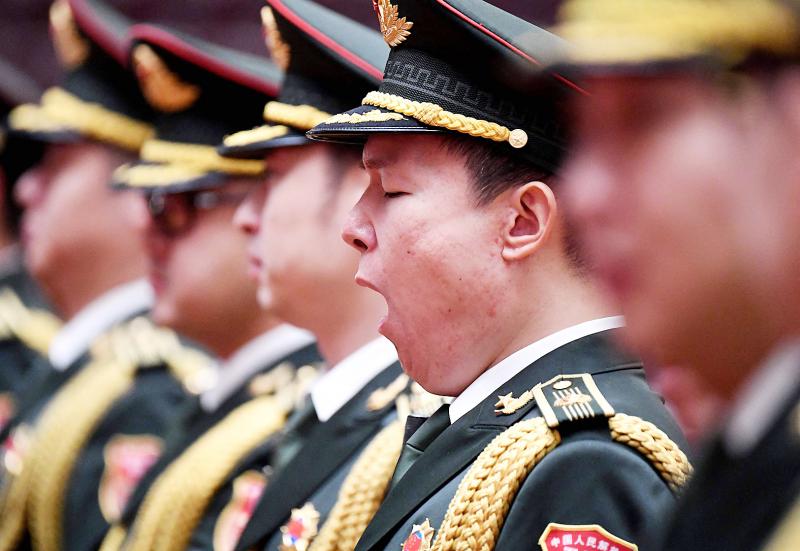
Photo: AFP
On Tuesday, the Economic Daily published a commentary urging the public “not to over-read” a Chinese Ministry of Commerce statement encouraging families to stock up on some daily necessities due to supply-chain concerns.
Then, late on Tuesday, a social media account affiliated with the official People’s Liberation Army Daily newspaper denounced the mobilization rumors as a “vile” and “malicious fabrication.”
“It will not only cause negative impact to the state, the military and society, it could also lead to severe consequences,” said the account, Junzhengping.
One screenshot of a text message widely circulated on social media urged reserves to “get ready for being recalled at any time” because “the Taiwan issue was very grim.”
Yesterday morning, the Junzhengping denial was among the top-trending topics on the Weibo social media network.
Still, the war talk continued to simmer, with a 63-year-old video of Chinese People’s Liberation Army generals singing that they “will definitely plant the flag of victory on Taiwan” getting more than 130 million views.
The controversy shows the challenge Chinese President Xi Jinping’s (習近平) government faces in trying to manage Chinese public sentiment over Taiwan, even with its vast censorship powers. Over months of saber-rattling over Taiwan, authorities have sometimes needed to step in to tone down the rhetoric and at other times faced backlash for perceived weakness.
The official China Daily newspaper warned in an editorial on Sunday that President Tsai Ing-wen (蔡英文) and her Democratic Progressive Party (DPP) were “leading Taiwan to an abyss.”
The paper cited a senior Chinese official’s pledge to spend the nation’s “post-unification” revenue on improving the well-being of its citizens as a remark that shows “confidence that the Taiwan question will be settled in the foreseeable future.”
Hu Xijin (胡錫進), the editor-in-chief of the Chinese Communist Party’s Global Times newspaper, offered a strategic rationale for the government’s rhetoric in a commentary published on Monday.
Hu said that “peaceful reunification” would likely result from applying enough pressure to make the DPP leadership believe it had no choice but to surrender.
“Personally, I believe there is still a chance for peaceful reunification, but it must be based on the condition that the DPP authority feels cornered and will perish if they do not accept reunification,” Hu said.
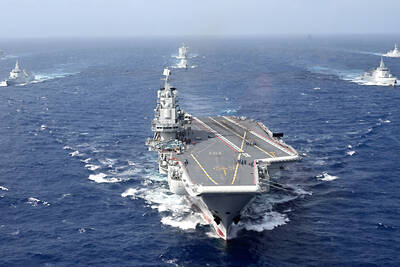
PROVOCATIVE: Chinese Deputy Ambassador to the UN Sun Lei accused Japan of sending military vessels to deliberately provoke tensions in the Taiwan Strait China denounced remarks by Japan and the EU about the South China Sea at a UN Security Council meeting on Monday, and accused Tokyo of provocative behavior in the Taiwan Strait and planning military expansion. Ayano Kunimitsu, a Japanese vice foreign minister, told the Council meeting on maritime security that Tokyo was seriously concerned about the situation in the East China and South China seas, and reiterated Japan’s opposition to any attempt to change the “status quo” by force, and obstruction of freedom of navigation and overflight. Stavros Lambrinidis, head of the EU delegation to the UN, also highlighted South China Sea
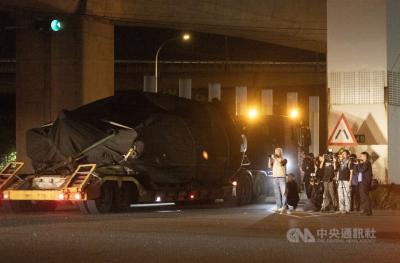
The final batch of 28 M1A2T Abrams tanks purchased from the US arrived at Taipei Port last night and were transported to the Armor Training Command in Hsinchu County’s Hukou Township (湖口), completing the military’s multi-year procurement of 108 of the tanks. Starting at 12:10am today, reporters observed more than a dozen civilian flatbed trailers departing from Taipei Port, each carrying an M1A2T tank covered with black waterproof tarps. Escorted by military vehicles, the convoy traveled via the West Coast Expressway to the Armor Training Command, with police implementing traffic control. The army operates about 1,000 tanks, including CM-11 Brave Tiger
Taiwan Semiconductor Manufacturing Co (TSMC, 台積電), the world’s largest contract chipmaker, said it expects its 2-nanometer (2nm) chip capacity to grow at a compound annual rate of 70 percent from this year to 2028. The projection comes as five fabs begin volume production of 2-nanometer chips this year — two in Hsinchu and three in Kaohsiung — TSMC senior vice president and deputy cochief operating officer Cliff Hou (侯永清) said at the company’s annual technology symposium in Silicon Valley, California, last week. Output in the first year of 2-nanometer production, which began in the fourth quarter of last year, is expected to

Taiwan’s drone exports surged past US$100 million in the first quarter, exceeding last year’s full-year total, with the Czech Republic emerging as the largest buyer, the Ministry of Economic Affairs said. Exports of complete drones reached US$115.85 million in the period, about 1.2 times the total recorded for all of last year, the ministry said in a report. Exports to the Czech Republic accounted for about US$100 million, far outpacing other markets. Poland, last year’s top destination, recorded about US$11.75 million in the first quarter. Taiwan’s drone exports have expanded rapidly in the past few years, with last year’s total


 RSS
RSS